

 Tiếng Việt
Bag thickness testing machines accurate to 0.001mm have completely transformed the quality inspection process at Hop Phat Specialized Bag Manufacturing. This equipment not only measures thickness but also analyzes material uniformity. The result is internationally compliant products with virtually zero defect rates. The following information will share details about this important equipment in garment manufacturing.
I. What is a Bag Thickness Testing Machine? Why is it Necessary?
1. Operating Principle of Thickness Measuring Machines
Packaging thickness measuring equipment operates based on three main principles: mechanical measurement, ultrasonic, and magnetic. Each method has its own accuracy and application in quality inspection.

Mechanical measurement method uses micrometer or caliper thickness gauge to measure the physical distance between two bag surfaces. Accuracy can reach ±0.001mm, suitable for PE bags, PP bags, and plastic film with thickness from 0.01mm to 12mm.
Ultrasonic technology uses high-frequency sound waves to measure response time through material. Ultrasonic thickness gauge is particularly effective with polyethylene bags, PVC bags, and composite packaging without direct contact.
2. Applications in Various Industries
Food industry requires food bags with uniform thickness to ensure storage capacity and hygienic safety. Hop Phat regularly supplies testing equipment for food packaging production factories.
Automotive industry uses thickness gauges to check airbags. Airbag seam thickness must meet strict standards to ensure accurate activation during collision.

Pharmaceutical industry requires medicine bags with accurate thickness to protect active ingredients from environmental effects. Micron measuring equipment helps ensure pharmaceutical packaging quality meets GMP standards.
II. Common Types of Bag Thickness Measuring Equipment Today
1. Mechanical Gauges (Micrometer/Caliper)
Digital micrometer is the most basic equipment in bag thickness testing. Hop Phat recommends this type for small businesses or startup labs due to reasonable cost and ease of use.

Outstanding advantages:
- Low investment cost from 2-5 million VND
- High accuracy ±0.001mm
- Simple maintenance, no need for complex calibration
- Direct measurement, instant results
Limitations: Slow measurement speed, depends on operator skill, not suitable for large-scale production.
2. Ultrasonic Gauges (Ultrasonic Gauge)
Ultrasonic thickness tester represents advanced technology in thickness measurement. This equipment uses ultrasonic waves for non-contact measurement, fast speed, and high accuracy.
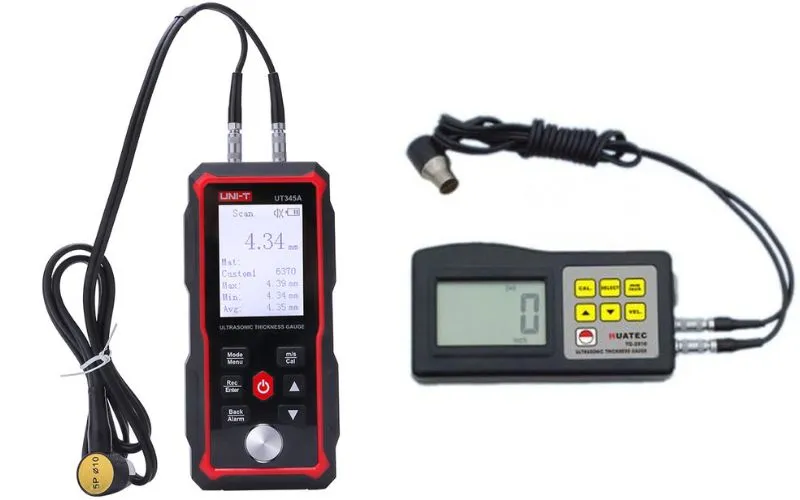
Working technology:
- Ultrasonic probe emits electromagnetic pulses
- Sound waves transmit through bag material
- Response time is automatically calculated
- Results displayed on LCD screen
Measurement range: 0.1mm – 500mm, suitable for diverse bag types from thin film to thick bags.
3. Magnetic Gauges (Magnetic Gauge)
Magnetic thickness gauge uses Hall Effect principle to measure non-magnetic materials. This specialized equipment is particularly effective with plastic bags on metal substrates.

Special applications:
- Check airbags
- Measure thickness on metal surfaces
- Inspect plastic coatings
III. International Standards for Bag Thickness Measurement
1. ASTM D374 and ISO 4593 Standards
ASTM D374 specifies standard methods for measuring thickness of plastic sheets and thin films. This standard requires test conditions at temperature 23±2°C and humidity 50±5%.
ISO 4593 focuses on measurement methods using mechanical equipment. Hop Phat always ensures equipment provided strictly complies with these regulations.
2. TCVN 5653:1992 Regulations in Vietnam
TCVN 5653:1992 is the Vietnamese standard for plastic bags. This regulation aligns with international standards but has adjustments suitable for Vietnam conditions.
Main requirements:
- Nominal thickness must be accurate ±10%
- Uniformity across entire surface
- Sampling method according to specific regulations
3. Units of Measurement: Micron, Mil, Gauge
| Unit | Conversion | Application |
|---|---|---|
| 1 Micron | 0.001mm | Thin film, supermarket bags |
| 1 Mil | 0.0254mm | Industrial bags, export packaging |
| 1 Gauge | 0.00001 inch | Stretch film, shrink wrap |
Conversion formulas:
- 1 Mil = 25.4 Micron
- 1 Gauge = 100 Mil
- 1 Micron = 4 Gauge
See more detailed articles:
- Handmade bag fabric is the material that determines the durability and aesthetics of handmade bag products.
- Paracord for bag making is popular in bag making thanks to high durability, good waterproofing, and modern aesthetics.
IV. Top 5 Highly-Rated Bag Thickness Testing Machines
Hop Phat has thoroughly researched and evaluated the leading products on the market to provide the most suitable recommendations for customers.
Feature and price comparison:
| Criteria | Mechanical | Ultrasonic | Magnetic |
|---|---|---|---|
| Price | 2-5 million | 15-30 million | 20-40 million |
| Accuracy | ±0.001mm | ±0.01mm | ±0.003mm |
| Measurement speed | Slow | Fast | Medium |
| Maintenance | Simple | Complex | Medium |
Recommendation: Small businesses should choose mechanical equipment, large factories prioritize ultrasonic technology, special applications need magnetic equipment.
In conclusion, we hope you now have a comprehensive view of bag thickness testing machines and the real value they bring. Hop Phat is always ready to consult and support customers in choosing the optimal solution for their quality inspection needs. Contact hotline 0909.938.333 now for consultation and quotes for custom bag manufacturing!